
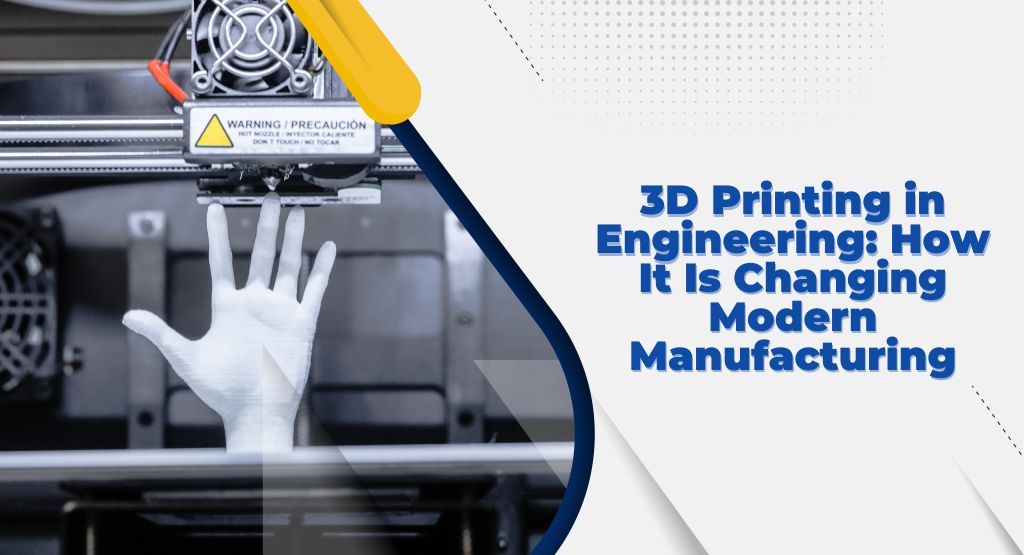
3D printing in engineering is transforming modern manufacturing by enabling engineers to create complex components faster, reduce material waste, build prototypes at lower cost, and customize products for specific applications. Also known as additive manufacturing, 3D printing is increasingly important in mechanical engineering, aerospace, automotive, healthcare, robotics, construction, and product development.
For students exploring engineering as a career, learning technologies such as 3D printing, robotics, artificial intelligence, and digital manufacturing can provide valuable exposure to the future of industry. Poornima Group of Colleges in Jaipur is strengthening engineering education through industry-oriented learning, specialised centres of excellence, innovation facilities, and technology-focused programmes.
What Is 3D Printing in Engineering?
Traditional manufacturing often involves cutting, drilling, moulding, or machining material to produce a component. 3D printing takes a different approach: it builds an object layer by layer from a digital design.
The process generally involves:
- Creating a 3D computer-aided design (CAD) model.
- Converting the design into printable layers.
- Selecting a suitable material and printing method.
- Producing the component layer by layer.
- Finishing and testing the final part.
This approach allows engineers to manufacture shapes that can be difficult or expensive to produce using conventional methods.
Why Is 3D Printing Important for Modern Manufacturing?
Faster Prototyping
Engineers can create and test prototypes much faster. Instead of waiting for specialised tooling or moulds, a digital design can be converted into a physical model relatively quickly.
Reduced Material Waste
Because additive manufacturing deposits material where it is required, it can reduce unnecessary material removal compared with some conventional manufacturing processes.
Greater Design Freedom
3D printing makes it possible to experiment with intricate geometries, lightweight structures, internal channels, and customised components.
Product Customisation
Industries can manufacture components tailored to specific requirements without necessarily producing large quantities of identical products.
Key Facts: Why Engineering Students Should Learn 3D Printing
| Area | Importance |
| Design | Supports advanced CAD and digital modelling |
| Manufacturing | Introduces additive manufacturing concepts |
| Innovation | Encourages rapid experimentation and prototyping |
| Industry | Connects engineering education with emerging technologies |
| Career skills | Builds practical knowledge relevant to modern engineering |
How Poornima Group of Colleges Connects Engineering Education With Digital Manufacturing
For students comparing the best engineering colleges in Jaipur, technology-enabled learning can be an important consideration. Poornima Group of Colleges has established a technology-focused ecosystem that includes RTU Centres of Excellence in AI & Big Data, Digital Manufacturing, Advanced Wireless Communication, and Robotics & AI. Its institutions also have AICTE IDEA Labs designed to support innovation and practical learning.
Poornima’s B.Tech portfolio covers disciplines including Computer Engineering, Artificial Intelligence & Data Science, Cyber Security, Information Technology, Mechanical Engineering, Civil Engineering, Electrical Engineering, and Electronics & Communication Engineering.
This multidisciplinary environment is particularly relevant because modern manufacturing increasingly combines mechanical systems with software, sensors, automation, robotics, artificial intelligence, and data analytics.
3D Printing and the Future of Engineering Careers
From Classroom Concepts to Industry Applications
The value of engineering education increasingly lies in applying theoretical concepts to practical problems. At Poornima, engineering students undertake internships intended to develop hands-on practice, technical skills, confidence, and exposure to real working environments.
This type of experiential learning can help students understand how technologies such as CAD, automation, digital manufacturing, AI, and 3D printing are used beyond the classroom.
Industry and Innovation Exposure
Poornima Group reports industry-collaborated certification programmes, technology-oriented laboratories, international academic collaborations, entrepreneurship initiatives, professional student chapters, and research support. The institution also reports more than ₹3 crore in research grants over the last three years from agencies including DST, AICTE, and TEQIP.
These opportunities are relevant for students looking beyond conventional engineering education and towards innovation-led careers.
Expert Insight: What Should Students Look For in an Engineering College?
When evaluating private engineering colleges in Rajasthan, students should consider more than rankings or campus infrastructure. A strong engineering education should ideally combine:
- Industry-oriented curriculum
- Practical laboratory exposure
- Emerging technology centres
- Research and innovation opportunities
- Internships and industry interaction
- Professional clubs and technical communities
- Strong placement preparation
- Accreditation and academic recognition
Poornima’s institutions state that they are AICTE-approved, affiliated with Rajasthan Technical University, and accredited by NAAC at A+ and A levels; they also state that the institutions are autonomous by RTU.
For students searching for a B.Tech institute in Rajasthan, these academic and industry-facing factors can provide a useful framework for comparing institutions.
Student Perspective: Why Learn 3D Printing?
From a student’s perspective, 3D printing makes engineering more tangible. A design that begins as an idea on a computer can become a physical prototype that can be tested, modified, and improved.
It can also encourage students to develop:
- Problem-solving ability
- Design thinking
- Prototyping skills
- Creativity and experimentation
- Understanding of manufacturing processes
- Interdisciplinary engineering knowledge
Students interested in a computer Science college in Rajasthan can also benefit from the convergence of software and manufacturing. Digital manufacturing increasingly relies on programming, data, simulation, AI, computer vision, and automation.
Pros and Cons of 3D Printing
Advantages
- Rapid prototyping
- Design flexibility
- Product customisation
- Potential material savings
- Useful for low-volume production
- Supports innovation and experimentation
Challenges
- Equipment and material costs can vary
- Printing speed may be unsuitable for some mass-production requirements
- Material choices can be application-specific
- Post-processing may be necessary
- Engineers need specialised design and manufacturing knowledge
Why This Matters for Students Choosing Engineering Colleges in Jaipur
Students researching the top colleges in Jaipur, or engineering colleges in Jaipur should look closely at how an institution prepares students for emerging technologies.
Poornima Group combines engineering programmes with technology-focused centres, AICTE IDEA Labs, research initiatives, industry collaborations, internships, professional student chapters, and entrepreneurship support. Its published information also highlights more than 5,500 quality placements and 300+ recruiters over the last three years.
Its placement information reports 350+ companies visiting campus and 1,700+ offers for the 2024 passing-out batch, while the 2025 figures listed on the placement page report a highest package of ₹15 lakh, average package of ₹4.18 lakh, and median package of ₹3.6 lakh.
For students seeking a best B.Tech placement college in Rajasthan, such published placement data can be a useful starting point for evaluating career opportunities alongside academics, skills, internships, and industry exposure.
10 Frequently Asked Questions About 3D Printing and Engineering
1. What is 3D printing in engineering?
3D printing is an additive manufacturing process that creates physical components layer by layer from a digital design.
2. How does 3D printing help engineers?
It helps engineers develop prototypes, test designs, create customized components, and explore complex geometries.
3. Is 3D printing useful for mechanical engineering?
Yes. It can support prototyping, product development, component design, tooling, and manufacturing research.
4. What industries use 3D printing?
Aerospace, automotive, healthcare, consumer products, construction, robotics, and industrial manufacturing use 3D printing.
5. Is 3D printing part of digital manufacturing?
Yes. It is one of the important technologies associated with modern digital and additive manufacturing.
6. What skills are useful for 3D printing?
CAD modelling, design thinking, materials knowledge, manufacturing fundamentals, and practical prototyping skills are valuable.
7. Can computer science students work in 3D printing?
Yes. Software, AI, data analytics, simulation, computer vision, and automation are increasingly connected with advanced manufacturing.
8. Why should engineering students learn emerging technologies?
Emerging technologies can strengthen practical skills and help students understand how engineering is evolving across industries.
9. What should students consider when choosing an engineering college?
Students should evaluate academic programmes, accreditation, laboratories, internships, industry exposure, research, innovation, placements, and overall learning opportunities.
10. Why consider Poornima Group of Colleges for engineering education?
Poornima Group offers multiple B.Tech disciplines and highlights technology-focused Centres of Excellence, AICTE IDEA Labs, industry collaborations, research initiatives, internships, and placement support.
Conclusion
3D printing is changing modern manufacturing from a process focused primarily on mass production to one increasingly driven by digital design, rapid prototyping, customisation, and innovation. As manufacturing becomes more connected with AI, robotics, automation, and digital technologies, engineers will need both strong fundamentals and practical exposure to emerging tools.
For students planning their engineering journey, choosing an institution that supports technology-driven learning can make a meaningful difference. Poornima Group of Colleges provides a multidisciplinary engineering environment supported by technology-focused Centres of Excellence, innovation facilities, industry interaction, research initiatives, internships, and career development opportunities.
Read More: Cybersecurity vs Cloud Security: Which Career Should You Choose?